
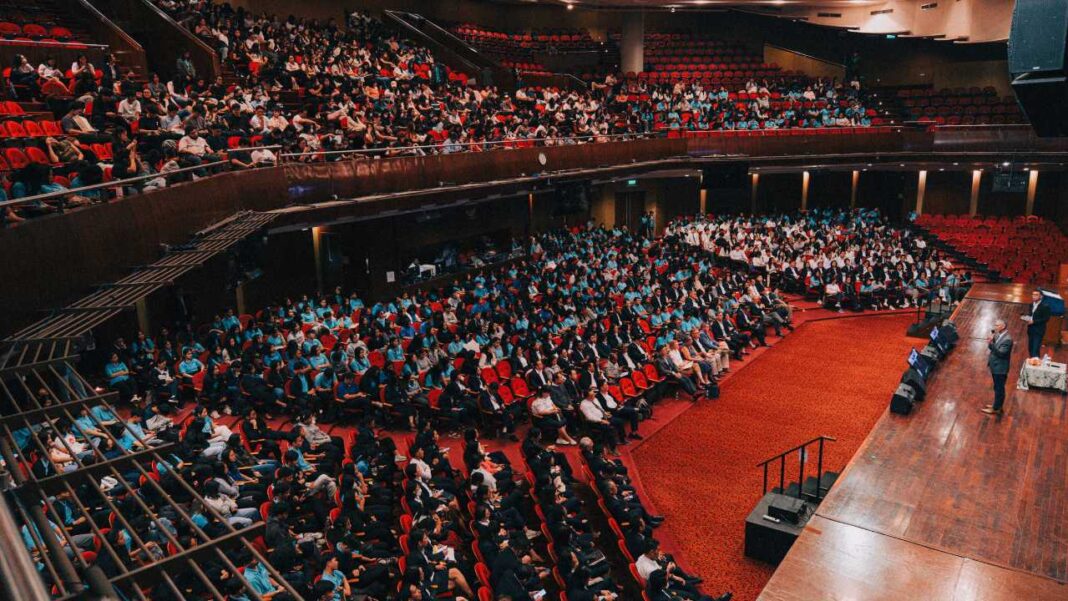
The integration of faith and learning has become increasingly vital in today’s educational landscape, particularly as institutions seek to provide holistic formation that goes beyond mere academic achievement. At Universitas Pelita Harapan (UPH), this vision came alive through a transformative two-day academic gathering that brought together international scholars and local educators to explore how Christian worldview can permeate every aspect of higher education.
UPH Public Lecture Series 2025: Building Education that Integrates Faith and Learning
Yayasan Pendidikan Pelita Harapan (YPPH) presented an inspiring academic and spiritual experience through the UPH Public Lecture Series 2025, held over two days on September 22-23, 2025, at the Grand Chapel and Faculty of Medicine Auditorium at UPH campus in Lippo Village, Karawaci, Tangerang. This event served as part of the pre-retreat series attended by UPH’s academic community, leading up to the culminating YPPH Annual Retreat 2025 on September 26. The entire series became a moment of reflection on faith and learning for the entire academic community.
The UPH Public Lecture featured six distinguished speakers from various disciplines, including education, engineering, technology, economics, business, and health. These presenters came from renowned Christian universities in the United States, such as Calvin University, Dordt University, and The Master’s University. Each speaker consistently demonstrated practical approaches to integrating Reformed theology into every aspect of learning.
Embracing Deep Integration Over Surface-Level Faith
Beyond expanding academic horizons, this public lecture series was designed to affirm each participant’s calling as servants of God. Moreover, the entire process of learning, research, and service is understood as Coram Deo—conducted in God’s presence, under His authority, and for His glory.
In his opening remarks, Dr. (Hon.) Jonathan L. Parapak, M.Eng., Sc., UPH’s Rector, emphasized UPH’s identity as Indonesia’s only university that makes faith in Christ the foundation of its vision. He expressed hope that this public lecture would become a space for reflection and inspiration for all participants.
“I hope this public lecture provides new ideas for moving forward. The world of education is full of challenges, but I believe we are all committed to doing our best for God’s glory,” he stated.
Living Out Christian Education Authentically
The lecture series opened with a session by Dr. Leah Zuidema, Vice President for Academic Affairs at Dordt University, who presented the topic “Moving Beyond Add-On Faith: Institutional Practices for Deep Integration.” She emphasized that faith is not merely a formality but must be genuinely lived and embodied throughout all fields of study and campus life. Faith integration, according to her, encompasses knowledge, action, relationships, and is rooted in Christ’s teachings.
“In education, we often unconsciously worship ‘other gods’—whether success, knowledge, or popularity. However, we are called to ensure that all aspects of learning are filled with the spirit and teachings of Christ,” she explained.
Engineering as God’s Creative Mandate
The second session featured Dr. Frederick Haan, Professor of Engineering at Calvin University, with the theme “Designing for Shalom: Deepening Faith Integration in Engineering and Technology.” He reminded participants that engineering is not just about technical capabilities but a calling to bring peace, wholeness, and joy (shalom) to society.
“A Christian engineer must remember that engineering is not merely formulas and technology, but a calling to serve others and create life that reflects God’s love,” he stated.
Economic Justice Through Christian Stewardship
In the third session, Dr. Sung Soo Lim, Associate Professor of Economics at Calvin University, delivered material on “Beyond Efficiency: Integrating Justice, Stewardship, and Hope in Economics.” He argued that economics is not merely about pursuing numbers and efficiency but must be grounded in values of justice and responsibility.
Furthermore, Dr. Lim challenged conventional economic thinking by demonstrating how Christian economic principles can reshape our understanding of wealth creation and distribution. Unlike secular approaches that prioritize profit maximization, he advocated for an economy rooted in biblical stewardship.
“Profit can become fuel to help others and support good work, as long as it is used responsibly, not for greed,” he emphasized.
The Sacred Role of Play in Learning
The second day began with a session by Dr. Brian Bolt, Dean of School of Education at Calvin University, who presented the topic “Forming Kingdom Teachers: Deeper Models of Faith-Integrated Pedagogy.” In his presentation, he highlighted the importance of play as an integral part of education. Through play, students not only have fun but also learn to collaborate, sharpen imagination, and discover joy in the learning process.
Dr. Bolt further reminded participants that Jesus himself emphasized faith like that of a child—characterized by humility, innocence, sincerity, pure trust, and an open heart to receive God’s Kingdom. This insight connects with research on play-based learning in Christian education that demonstrates its effectiveness in holistic development.
“Play is not just an activity, but also an attitude of the heart. God calls us to live with joy, not with fear,” Dr. Bolt remarked.
Business as Reflection of Divine Character
The fifth session was led by Dr. John Beck, Dean of School of Business & Communication at The Master’s University, with the theme “Faithful Influence: Integrating Faith into Business Strategy and Public Communication.” He emphasized that business reflects the character of its leaders. For Christians, working and doing business is not merely economic activity but also a means of witnessing faith.
“Business is never just about business. Through leadership style, strategy, organizational culture, and how we communicate, we are showing who God is and what His character is like,” Dr. Beck asserted.
Compassionate Care as Christian Calling
As the series conclusion, Dr. Melanie Wynja, Professor of Nursing at Dordt University, presented material on “Compassionate Care and Christian Calling: Integrating Faith into Nursing Practice and Education.” She invited participants to reflect on the essence of compassionate service in light of Christian faith—a calling that extends beyond nursing and healthcare to touch every aspect of life and profession.
Quoting Colossians 3:12, Dr. Wynja emphasized the calling to live with compassion, kindness, gentleness, and patience, as Christ has exemplified.
“The nursing profession is a noble calling. Be nurses who bring human touch while radiating Christ’s love wherever you are placed,” she conveyed.
Comprehensive Faith Formation Through YPPH’s Vision
Leading up to the climax of YPPH Annual Retreat 2025, YPPH presented a series of pre-retreat programs specifically designed to equip the community. Besides the UPH Public Lecture Series, there were two other important programs that affirmed YPPH’s commitment to integrating faith and learning across all educational levels.
First, the Special Parent & Student Session: Integration of Faith and Learning (September 21, 2025), aimed at UPH parents and students, as well as parents and students from YPPH schools. Second, the SPH Teacher Enrichment Program (September 24, 2025), which focused on leaders and teachers from YPPH schools to deepen their calling as Christian educators at elementary and secondary education levels.
The entire series concluded with the YPPH Annual Retreat 2025 on September 26, 2025, which carried the theme “Coram Deo — In the Presence of God: Reflections on the Biblical Christian Worldview.” This event became an important moment for the entire YPPH community to reflect, deepen, and live out faith in every aspect of learning, working, and creating—lived fully in God’s presence.
A Blueprint for Authentic Christian Higher Education
The UPH Public Lecture Series 2025 demonstrated that authentic integration of faith and learning requires more than superficial references to spirituality. Instead, it demands a comprehensive transformation of how we approach knowledge, relationships, and service across all academic disciplines. Through the diverse perspectives shared by international scholars, participants gained practical insights into living out their Christian calling in engineering, economics, education, business, and healthcare.
As institutions worldwide grapple with questions of purpose and meaning in education, UPH’s commitment to Coram Deo living offers a compelling model for Christian higher education. The series not only enriched academic understanding but also challenged participants to view their professional callings as sacred opportunities to reflect God’s character and advance His kingdom in their respective fields.