
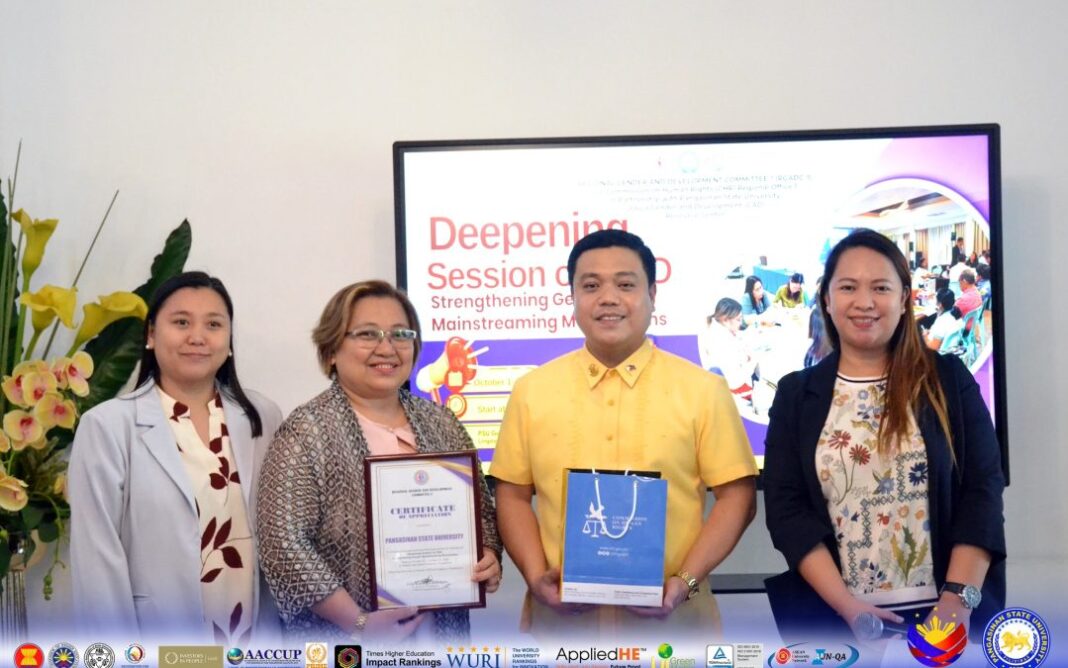
Pangasinan State University continues to cement its reputation as a national leader in gender advocacy by hosting critical training sessions that could reshape how Region I approaches gender mainstreaming. The three-day event signals intensified efforts to build a robust network of Gender and Development champions across government agencies and academic institutions.
**Key Points**
- PSU hosted RGADC-1’s intensive training program for potential Region I GAD Resource Pool applicants from October 1-3, 2025
- Six specialized sessions covered fundamental GAD concepts, gender analysis tools, and policy crafting methodologies
- Participants represented diverse regional line agencies, state universities, colleges, and local government units
- Training emphasized transforming advocacy into actionable policies and sustainable development practices
How RGADC-1 and PSU are deepening GAD advocacy through strategic capacity building
Why did Region I prioritize this intensive GAD training initiative?
The Regional Gender and Development Committee-1 (RGADC-1) recognized an urgent need to strengthen the region’s capacity for gender mainstreaming training across multiple sectors. Consequently, they partnered with Pangasinan State University to deliver the Leveling and Deepening Session program on Gender Analysis and GAD Tools at PSU’s Golden Lion Hotel in Lingayen, Pangasinan.
University President Dr. Elbert M. Galas emphasized that empowerment encompasses multiple dimensions including voices, experiences, and goals, all interwoven in collaborative endeavors. He stressed that trainings must translate into concrete actions by creating spaces for women to share experiences, supporting one another, and transforming personal stories into meaningful policies and measurable progress.
Building the Region I GAD Resource Pool
RGADC-1 Secretary Atty. Anna Leah Romero of the Commission on Human Rights explained that participants would strengthen their understanding of gender mainstreaming mechanisms through the Deepening Session. Additionally, they would master the process of crafting tailored GAD agendas specific to their respective agencies and localities.
The stakes for effective gender advocacy have never been higher.
What specific methodologies did the training program cover?
The comprehensive curriculum unfolded across six specialized sessions, each targeting critical competencies for GAD implementation:
- Basic GAD Concepts presented by Dr. Juan Primitivo Petrola of PSU
- Gender Analysis techniques delivered by Ms. Jhana Gagucas of DEPDEV
- Gender Mainstreaming Evaluation Framework (GMEF) taught by Mr. Jareason C. Fabre of MMSU
- Harmonized Gender and Development Guidelines (HGDG) explained by Ms. Mariz Dafnae H. Mendoza of DEPDEV
- Crafting GAD Agendas facilitated by Ms. Kristine Anne V. Lee, Senior GAD Specialist from the Philippine Commission on Women
- Administration of GFAST Tool demonstrated by Mr. Ariel Del Rosario Rivera, Senior GAD Specialist from the PCW
Expert facilitators from multiple institutions
The program drew expertise from various organizations including PSU, DEPDEV, MMSU, and the Philippine Commission on Women. Notably, PSU’s Dr. Presley V. De Vera and the technical working group documented the proceedings to ensure knowledge transfer and future reference.
Who participated in this regional capacity-building initiative?
University GAD Director Dr. Romary R. Lincod joined President Galas in welcoming participants from diverse regional line agencies, state universities, colleges, and local government units. This cross-sectoral representation ensured that GAD advocacy strategies would reach multiple levels of governance and institutional frameworks.
Furthermore, the initiative underscores RGADC’s commitment to building a stronger pool of GAD champions capable of driving inclusive, evidence-based, and sustainable development throughout the region.
Bottom Line
This intensive training program represents a strategic investment in Region I’s gender advocacy infrastructure, positioning participants to become effective GAD champions within their respective organizations. The collaboration between RGADC-1 and PSU demonstrates how academic institutions can serve as catalysts for social transformation through targeted capacity building.
Moving forward, the success of this initiative will be measured by how effectively participants implement their newly acquired skills to advance gender mainstreaming policies and programs across Region I’s diverse institutional landscape.