
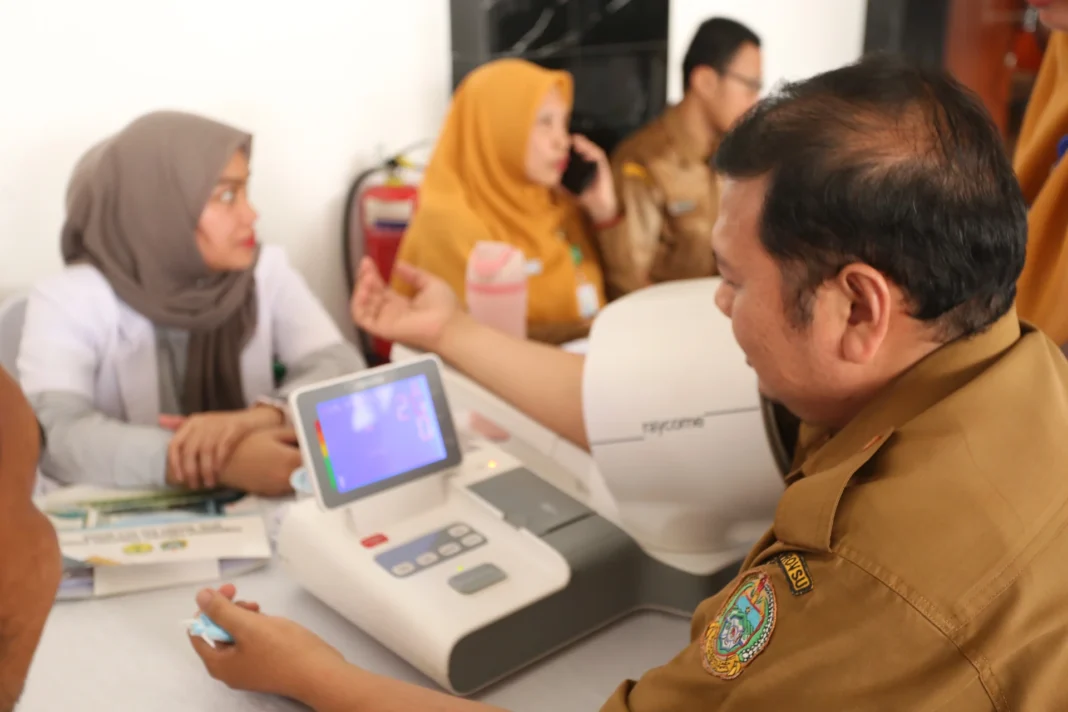
The province of North Sumatra has officially launched its Universal Health Coverage (UHC) initiative while achieving 100.2% participation in the national health insurance program. This milestone demonstrates how regional governments and academic institutions can collaborate to transform healthcare delivery and professional education.
**Key Points**
* North Sumatra achieved 100.2% participation in Indonesian Health Insurance program, surpassing national targets
* Universitas Sumatera Utara integrated UHC principles across medicine, pharmacy, and public health curricula
* Provincial government emphasizes zero-excuse policy for healthcare access regardless of hospital capacity
* Cross-sector collaboration includes digitalization through integrated dashboards and mobile applications
* Academic institutions serve as strategic partners beyond traditional observer roles
How Does North Sumatra’s UHC Success Transform Healthcare Education?
What makes this UHC launch strategically significant?
The September 29, 2025 launch at Grha Bhineka Perkasa Jaya represents more than administrative ceremony. Consequently, it showcases how higher education institutions can actively shape healthcare policy implementation rather than merely responding to market demands.
Strategic partnership model emerges
Universitas Sumatera Utara (USU) positioned itself as a strategic partner in preparing future healthcare professionals who understand Universal Health Coverage principles comprehensively. Prof. Dr. dr. Muhammad Fidel Ganis Siregar, USU Secretary, emphasized this educational transformation extends beyond clinical training.
“UHC is not merely about clinical matters—it also concerns health equity, financing, and service systems. For this reason, the UHC concept has been integrated into the curricula of medicine, pharmacy, public health, and other related fields at USU,” Prof. Fidel explained.
Why does curriculum integration matter for healthcare delivery?
Traditional medical education often compartmentalizes clinical skills from healthcare systems thinking. In contrast, USU’s approach cultivates researchers and innovators capable of providing health policy recommendations at both local and national levels.
Comprehensive healthcare framework implementation
Through its teaching hospitals and affiliated networks, USU serves as a practical UHC implementation model. This encompasses promotive, preventive, curative, rehabilitative, and palliative healthcare programs within a single educational framework.
The implications extend far beyond regional boundaries.
What performance metrics validate this approach?
Head of the North Sumatra Provincial Health Office, H. Muhammad Faisal Hasrimy, reported impressive participation statistics as of September 1, 2025:
| Metric | Achievement |
|---|---|
| Indonesian Health Insurance participation | 100.2% |
| Activity rate | 80.27% |
| UHC Priority status | Achieved ahead of national target |
These figures position North Sumatra among provinces successfully achieving UHC Priority status before national deadlines. Notably, this success correlates with the province’s investment in educational infrastructure and cross-sector collaboration.
How does leadership commitment drive implementation?
Governor emphasizes service guarantee principles
Governor M. Bobby Afif Nasution stressed that UHC must deliver tangible benefits rather than administrative formalities. His directive eliminates common healthcare access barriers.
“There should be no excuses for full hospital rooms or limited quotas. Every resident of North Sumatra who needs healthcare services must be properly served,” Governor Nasution asserted.
Digital innovation accelerates access
David Bangun, Director of Membership at BPJS Kesehatan, expressed support for healthcare service digitalization through integrated dashboards and mobile JKI applications. These innovations simplify public access to health information and services across the province, complementing the educational reforms at healthcare technology integration initiatives.
Bottom Line
North Sumatra’s UHC success demonstrates how strategic partnerships between government and academic institutions can accelerate healthcare transformation. The integration of UHC principles into university curricula ensures future healthcare professionals understand system-wide challenges beyond clinical competencies.
This model offers replicable insights for other regions seeking to achieve universal health coverage targets while building sustainable healthcare workforce capacity. The next phase will likely focus on scaling digital innovations and measuring long-term patient outcomes across the integrated delivery system.