
Have you ever wondered what happens when ambitious computing students tackle space robotics and AI challenges on the global stage? Five talented individuals from INTI International College Penang just proved that Malaysian students can compete with the world’s best, bringing home prestigious awards from two major technology competitions in September 2025.
INTI Students Win Awards in Space Robotics and Global Hackathon Competitions
Double Victory in Cyberjaya’s Tech Arena
These five computing students from INTI International College Penang demonstrated exceptional innovation and teamwork by earning awards in two major technology competitions. Meanwhile, both events took place in Cyberjaya this September, creating a remarkable month of achievements for the institution.
The competitions—the Kibo Robot Programming Challenge (Kibo-RPC) 2025 and the UST Global 24-hour Hackathon (D3CODE 2025)—tested different aspects of technological prowess. As a result, the students showcased their versatility across space robotics and AI-driven solutions.
Programming Robots for the International Space Station
At the Kibo-RPC 2025 National Level Competition, the INTI team secured an impressive second place. This competition, organised by the Japan Aerospace Exploration Agency (JAXA) in collaboration with NASA and coordinated by the Malaysian Space Agency (MYSA), required participants to operate Astrobee and Int-Ball robots in a simulated space environment.
The challenge was no simple task—teams had to locate hidden treasures using precision programming and control of robotic systems aboard the International Space Station (ISS). Judges assessed participants on the accuracy, efficiency, and smoothness of their coding and robotic movements.
“Participating in the Kibo-RPC 2025 program has truly broadened our horizons. From planning to implementation, every step tested our creativity and patience. Seeing our work tested in the space simulator and achieving second place was our proudest moment.”
Team leader Teh Yao Sheng’s reflection captures the intensity of this space robotics challenge. His teammate, Cheong Wei Xun, shared similar enthusiasm: “The Kibo-RPC presented a unique, real-world challenge that sounded incredibly cool and unlike anything we’d done before. We started just for fun, but through teamwork and continuous learning, we achieved something we never expected.”
AI Innovation for Social Impact
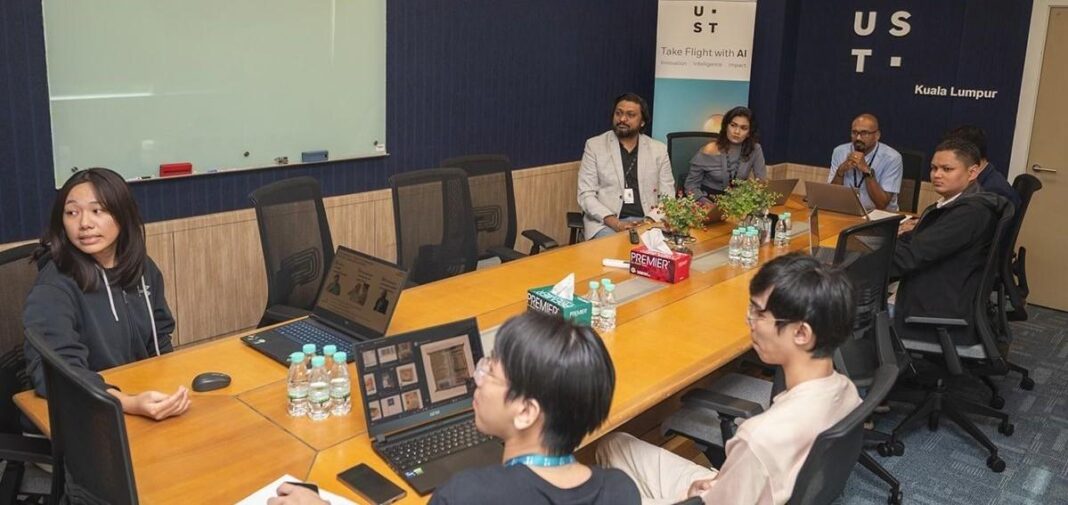
Building on their space robotics success, another group of INTI Penang students proved their creativity at the UST Global 24-hour Hackathon. This worldwide innovation challenge, themed “Shaping New Frontiers – Data, Intelligence, and Quantum,” invited participants to develop AI, quantum, and data-driven solutions addressing real-world issues.
The team’s project, EAR-EYE, earned the runner-up position in the Malaysia edition. For instance, this AI-powered mobile app for the elderly integrates multiple cutting-edge technologies to enhance safety, independence, and well-being.
EAR-EYE: Technology Meets Compassion
The innovative application demonstrates how artificial intelligence can transform healthcare accessibility. EAR-EYE incorporates several key features:
- Optical Character Recognition (OCR) that reads printed text aloud
- Real-time audio alerts for users with hearing loss
- Allergen detection capabilities for dietary safety
- An empathetic AI chatbot providing companionship
“Our hackathon journey was a practical lesson in turning an idea into reality,” explained team member Tan Hong Zheng. “The 24-hour challenge was intense but rewarding. We learned to think quickly, work strategically, and push our limits under pressure.”
Educational Excellence Through Experiential Learning
These achievements highlight INTI’s commitment to hands-on education and STEM excellence. Kavitha Thamadharan, Senior Lecturer and Head of Programme at INTI Penang’s School of Computing, emphasised how these competitions develop essential skills beyond technical expertise.
“These achievements reflect INTI’s strong focus on experiential learning, STEM excellence, and innovation,” she noted. “Our students have shown that they can apply classroom knowledge to solve real-world challenges, whether in programming robots for space missions or designing AI-driven solutions for social good.”
Furthermore, such competitions align with global trends in STEM education initiatives by leading space agencies. The hands-on approach prepares students for careers in engineering, technology, and research by emphasising project-based experiences.
A Foundation for Future Innovation
Hemalatha Murugiah, Chief Executive of INTI International College Penang, summarised the significance of these victories: “Winning at both the Kibo-RPC and UST Hackathon reflects the kind of practical, forward-thinking education we strive to provide. It is about helping students translate what they learn into real outcomes, the kind of experience that prepares them for careers in STEM, technology, and beyond.”
These dual victories demonstrate that Malaysian students possess the creativity, technical skills, and determination to excel on international platforms. From programming space robots to developing compassionate AI solutions, INTI’s computing students have proven that innovation knows no boundaries. Their success serves as inspiration for aspiring technologists and reinforces Malaysia’s growing reputation in the global technology landscape.