
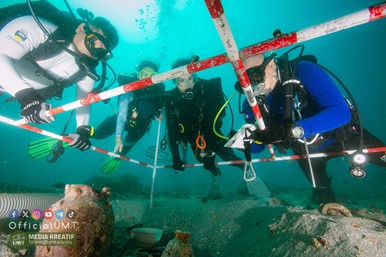
You witness history unfolding beneath the crystal-clear waters of Bidong Island as Her Highness Tengku Puteri Utama Raja descends alongside seasoned archaeologists, her diving gear cutting through the depths toward a 16th-century shipwreck. We’re watching something unprecedented: Malaysian royalty actively participating in underwater excavation, transforming what began as an academic conference into a moment of national significance.
ASEAN Underwater Archaeological Meet Up 2025 Becomes More Prestigious with Tengku Puteri Utama Raja’s Presence
Catalyst
The spark that ignited this extraordinary convergence began when Universiti Malaysia Terengganu (UMT) and the Department of National Heritage (JWN) joined forces to organize something ambitious. Their vision extended beyond typical academic gatherings—they sought to create a platform where underwater archaeology expertise across ASEAN nations could flourish through hands-on collaboration.
However, what transformed this scholarly pursuit into something truly remarkable was the involvement of Her Highness Tengku Puteri Utama Raja, daughter of His Royal Highness the Sultan of Terengganu, serving in her capacity as UMT’s Conservation Ambassador. Her deep passion for scuba diving and underwater photography had already established her credentials beneath the waves.
Meanwhile, Bidong Island waited patiently, its maritime secrets buried in sediment and time, ready to reveal stories from Malaysia’s rich trading past.
Rising Action
From September 18th to 22nd, 2025, the ASEAN Underwater Archaeological Meet Up and Bidong Shipwreck Excavation Phase Five brought together underwater archaeologists from Indonesia, Singapore, Thailand, and experts from Flinders University, Australia. Yet the real drama unfolded when Tengku Puteri Utama Raja chose to become more than a ceremonial presence.
Instead of remaining on the surface as a guest of honor, Her Highness suited up and descended into the depths alongside the research team. According to Baharim Mustapa, UMT’s technical director for archaeological diving and scientific diving instructor, this decision created an electric atmosphere among participants.
“Her Highness demonstrated strong interest in the nation’s maritime heritage and even joined other divers underwater. This is an honour and a symbol of support for efforts to preserve our national treasures,” he explained.
Below the surface, the excavation work intensified as team members carefully uncovered ship remains—planks weathered by centuries of saltwater, keel timbers that once guided vessels through ancient trade routes, and wooden pegs that held maritime dreams together.
Turning Point
Her involvement drew attention that transformed everything.
As Tengku Puteri Utama Raja demonstrated genuine enthusiasm for observing and recording the archaeological process, something shifted within the entire expedition. The presence of Malaysian royalty actively participating in underwater heritage preservation sent ripples through the international archaeological community present.
The breakthrough moment came when the team achieved their primary objective: examining the original wooden structure of the Bidong Shipwreck. The discovery of flooring and keel sections provided unprecedented insights into 16th-century shipbuilding technology and the intricate maritime trade networks that once connected Southeast Asian ports.
Subsequently, Her Highness visited the Bidong Island Marine Natural Research Station, where she observed the meticulous conservation process. Here, artifacts salvaged by UMT staff and postgraduate students underwent initial desalination—a crucial step since centuries of marine immersion had left salt deposits threatening each item’s physical integrity.
Resolution
The fifth phase excavation concluded with remarkable success, having fulfilled its core mission of documenting the maritime archaeology techniques needed to preserve Malaysia’s underwater cultural heritage. The rescued artifacts now undergo careful treatment to ensure their survival for future generations.
Moreover, the programme achieved something beyond archaeological objectives—it demonstrated how royal patronage can elevate heritage conservation efforts to new heights of visibility and importance. The international participants witnessed Malaysia’s commitment to preserving its maritime legacy through both scholarly rigor and symbolic leadership.
As word of this historic collaboration spreads throughout academic and heritage circles, UMT and JWN’s reputation as leaders in Malaysia’s underwater archaeology continues strengthening, while Bidong Island gains recognition as a national heritage site deserving international attention and protection.
This convergence of royal passion, scientific expertise, and cultural preservation creates a powerful model for heritage conservation across Southeast Asia, proving that when leadership dives deep—literally and figuratively—into preserving our past, the impact resonates far beyond the immediate discovery.