
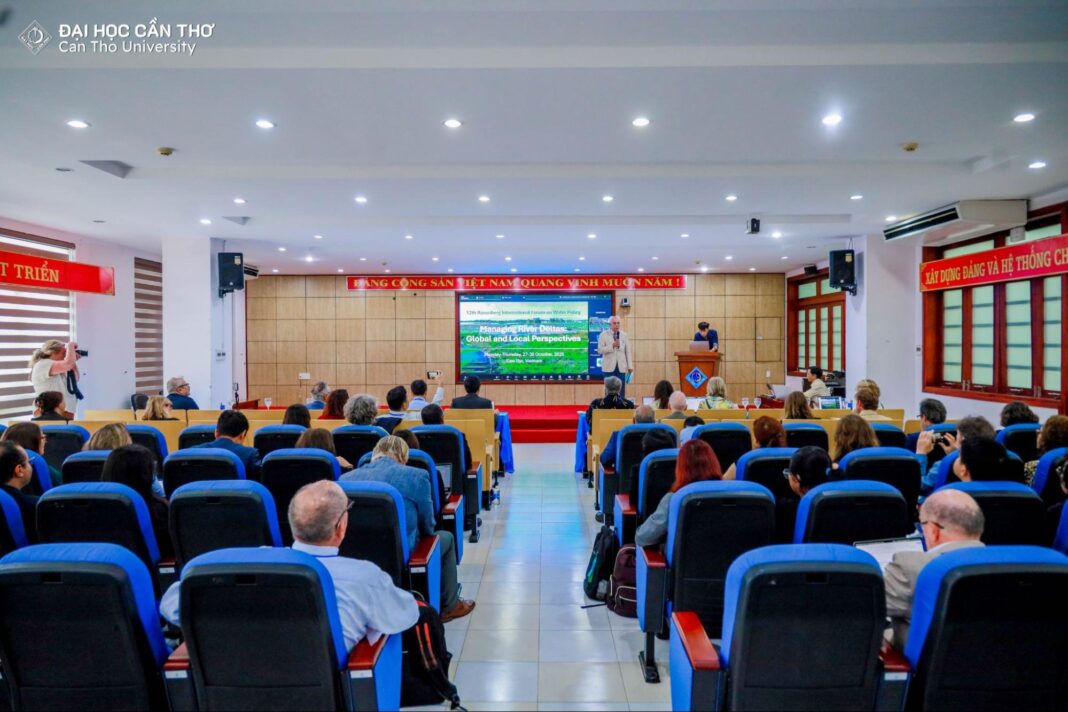
You walk into the administrative building at Can Tho University on a crisp October morning, where the air buzzes with anticipation as delegates from over a dozen countries gather for what promises to be a landmark scientific forum. We witness the convergence of global expertise and local wisdom as the 12th International Rosenberg Forum unfolds with the theme “River Delta Management: Global and Local Perspectives.”
Can Tho University Partners with 12th International Rosenberg Forum on River Delta Management
On the morning of October 29, 2025, Can Tho University (CTU) collaborated with the University of California (USA) and the Botin Foundation (Spain) to organize the 12th International Rosenberg Forum with the theme “River Delta Management: Global and Local Perspectives.” This prestigious scientific event, held biennially, focuses on sharing experiences, approaches, and innovative solutions for global water resource challenges, shaped by the natural, cultural, and economic conditions of each locality.
Catalyst
The forum took place against the backdrop of river deltas worldwide—particularly the Mekong Delta—suffering severe impacts from climate change, saltwater intrusion, land subsidence, and declining water resources. The decision to host the program at CTU demonstrates the deep concern of the international scientific community for this region rich in potential but also full of challenges.
This gathering represents a pivotal moment where global science meets local reality.
The distinguished attendees included Prof. Dr. Tran Ngoc Hai, Vice Rector of CTU; Prof. Soroosh Sorooshian, Forum Chairman and Distinguished Professor of Civil & Environmental Engineering and Earth System Science at the University of California, Irvine (USA); Ms. Glenda Humiston, Vice President of Agriculture and Natural Resources at the University of California (USA); and Mr. Alberto Garrido, Director of the Water Observatory at the Botin Foundation (Spain). Notably, the event brought together over 50 delegates including scientists, policy experts, leaders of international organizations, and representatives from universities across numerous countries.
Rising Action
The forum’s objectives emerged as threefold: First, promoting global cooperation by encouraging meaningful dialogue and knowledge sharing among researchers, experts, and policymakers worldwide. Second, connecting science and policy through exploring the crucial role of science in shaping effective water management policies and strategies. Third, creating an environment for deep interaction to facilitate in-depth discussions about water management science and practices across global regions.
Speaking at the program, Prof. Dr. Tran Ngoc Hai emphasized that CTU felt deeply honored to co-organize and host the 12th International Rosenberg Forum. As the leading university in the Mekong Delta region, the institution remains committed to education, research, and knowledge sharing serving the sustainable development of the region and the entire country.
Meanwhile, CTU actively collaborates with international partners in the fields of climate change, water resources, sustainable agriculture, and delta management strategies. Hosting the Rosenberg Forum presented a precious opportunity to connect international experts with local realities, thereby affirming CTU’s role as a regional research and policy development center aimed at sustainable delta management.
Turning Point
In his opening remarks, Prof. Soroosh Sorooshian shared that the 12th International Rosenberg Water Policy Forum with the theme “River Delta Management: Global and Local Perspectives” occurs in the context of water resources facing numerous pressures such as population growth, urbanization, migration, and extreme climate phenomena. The theme and focus of discussions on Mekong Delta issues proved both timely and practically significant.
“The lessons learned and management models from the Mekong River basin will bring tremendous reference value to other river systems worldwide,” he affirmed.
During the program, delegates representing numerous international research institutions and universities presented papers revolving around integrated water resource management, climate change impacts, and sustainable development directions for deltas worldwide. The reports focused on analyzing the historical, socio-economic, and environmental characteristics of the Mekong Delta; sharing experiences in delta management in the USA, China, and Argentina; while introducing research initiatives, scientific cooperation models, and technological solutions aimed at restoring and protecting freshwater ecosystems.
Resolution
Subsequently, participants engaged in discussions and posed questions, bringing not only multidimensional perspectives on global challenges but also affirming the importance of international cooperation in preserving the prosperity of delta regions. The forum demonstrated how scientific collaboration can bridge the gap between global water management challenges and local solutions.
The 12th International Rosenberg Forum held in Vietnam affirmed a special position in the global scientific cooperation network on water resource management and sustainable development. CTU clearly demonstrated its pioneering role in connecting and gathering leading world experts; disseminating scientific knowledge values, policy planning, and local practices; promoting international dialogue and cross-sector cooperation toward sustainable development.
Through in-depth discussion sessions and multidimensional exchanges, the forum contributed to shaping a global vision for delta management in the context of climate change, while opening new cooperation directions aimed at protecting and promoting the value of freshwater ecosystems—the foundation for humanity’s sustainable development. This landmark event establishes a blueprint for future collaboration between international research communities and local stakeholders, ensuring that scientific innovation continues to address the pressing water management challenges facing river deltas across the globe.